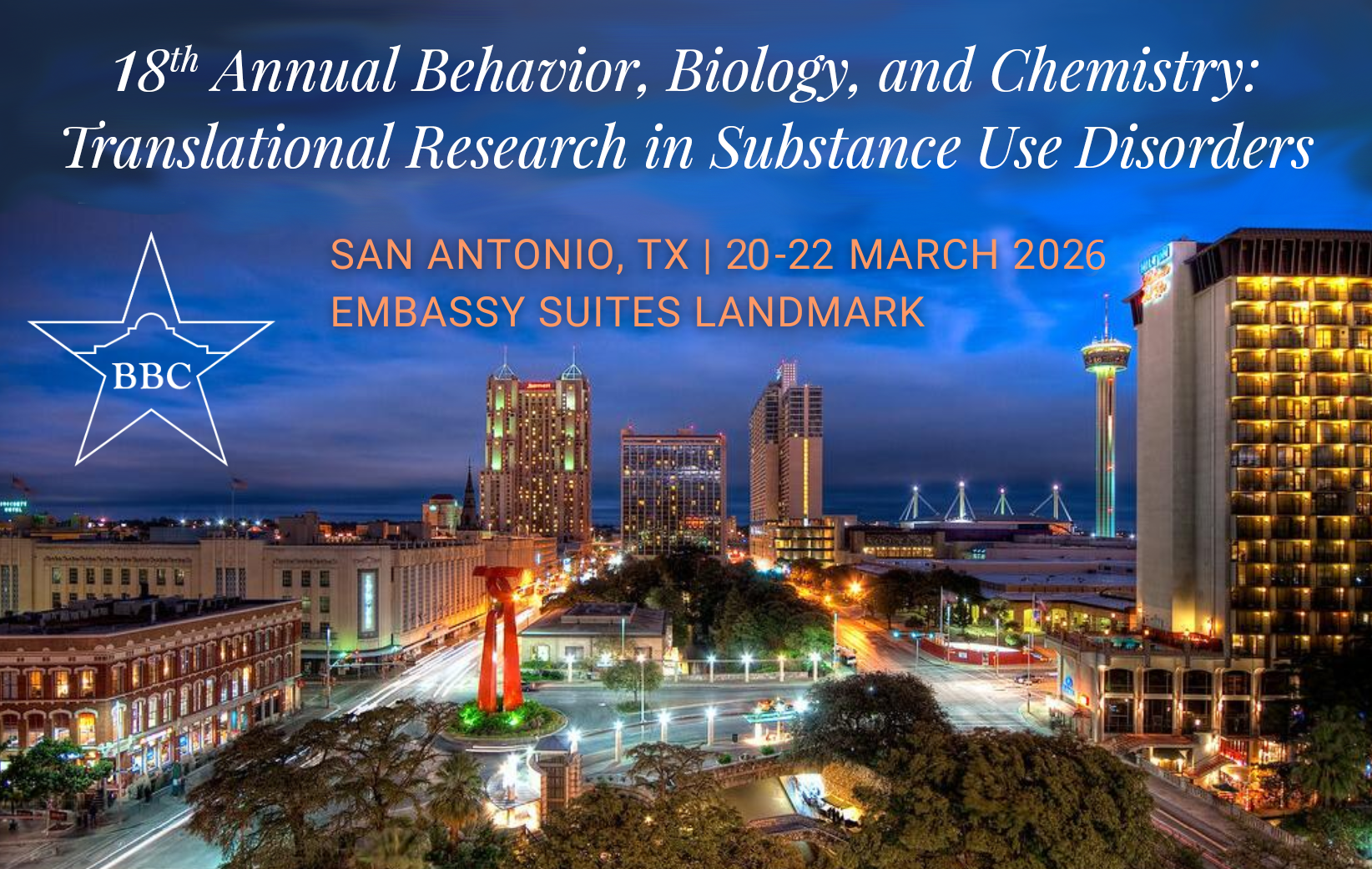
About the Event
This conference focuses on translational aspects of substance use research among chemists, biologists, and behavioral scientists. The diversity of participants and attendees at this meeting (undergraduate students to senior faculty, chemists to psychiatrists) provides a unique venue for networking among different disciplines and in so doing promotes new and innovative approaches to medications development in addictions biology. The meeting provides a stimulating environment for young scientists who are strongly encouraged to present their work and interact with senior scientists. The BBC meeting has served as a “launch pad” for many young, innovative investigators to join the ever-growing world of SUD research.
Special Lectures
 |
Margaret (Meg) Haney, PhDColumbia University |
Human behavioral pharmacology of cannabisThis presentation will describe how human laboratory investigations of cannabis, guided by the principles of behavioral pharmacology (positive and negative reinforcement; time course; dose dependence; behavioral specificity) advance our understanding of cannabis as a substance of misuse and as a potential therapeutic. |
|
 |
Susruta Majumdar, PhDWashington University in St. Louis |
Allosteric control of opioid receptor function using structure based designMajumdar Lab aims to develop therapeutics for pain and substance disorders integrating chemistry with structural biology and pharmacology. Dr. Majumdar is a co-founder of Sparian Biosciences. Two drugs developed by lab trainees are in phase 1 clinical trials and/or late stage development. |
Plenary Symposium
Kratom: From plant to policy
 |
Abhisheak Sharma, MPharm, PhDUniversity of Florida |
Kratom: History and Medicinal ChemistryThis talk will detail the history of traditional kratom use, along with modern uses. It has been described to have a paradoxical profile of stimulant and sedative depending on the amount consumed. Based on the recently gained pharmacological knowledge of the various alkaloids, these uses are demystified. This will also cover some of the recent kratom-derived synthetic products that have appeared in commerce. --> |
|
 |
Jenny Wilkerson, PhDRutgers University |
The kratom alkaloid mitragynine as a novel therapeutic for cancer-related pain relief and substance use disorders
|
|
 |
Oliver Grundmann, PhDUniversity of Florida |
The Kratom pharmacology puzzle pieces: How user surveys inform a complex pharmacological interplay |
|
 |
Jack Henningfield, PhDPinney Associates |
Kratom, Mitragynine and 7-hydroxymitraginine: Abuse Potential and Implications for DEA Scheduling and Policy to Mitigate Unintended ConsequencesKratom leaves contain more than 40 alkaloids that vary widely in their mechanisms of action and effects. Mitragynine (MG) and its metabolite 7-hydroxymitragynine (7-OH) contribute to kratom effects. Some marketed products contain only MG or 7-OH as active ingredients. 7-OH has demonstrated higher abuse potential and other safety risks than MG and natural kratom leaf products. 7-OH appears to meet criteria for Controlled Substances Act (CSA) scheduling. Implications for CSA scheduling and accompanying policy and research will be presented. |